

Cornerstone
I had to unlearn everything I knew about God just to find Him.
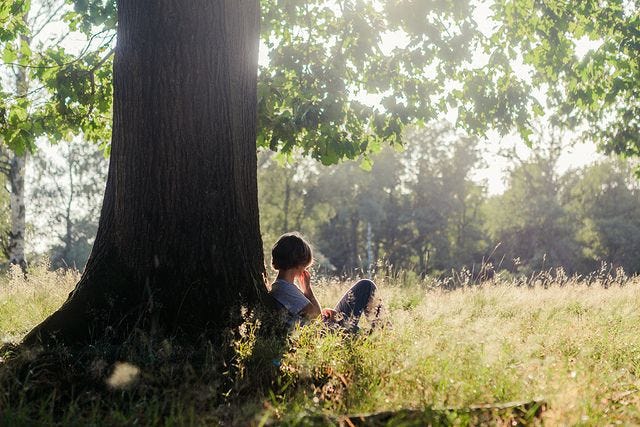
I grew up in a Protestant household, so we were planted in church every single Sunday. I was a Sunday-school kid through and through. Between choir practice, summer Bible school, youth camps, and outreach projects, my life pretty much revolved around the church. In our house, missing a service was never an option.
Church wasn’t just a place we went to worship… it was home. Because it was a small church, everyone knew everyone, and everybody looked out for each other. Those early years gave me a strong sense of belonging and truly shaped how I viewed faith and community. From the outside, you’d probably think I had it all figured out, that I’d read the Bible cover to cover, always knew the right things to say, and never felt lost.
I honestly don’t know when things started to shift. But a tiny crack opened up inside me, maybe when I was around 15. One Sunday, I remember standing in church during praise and worship, looking around at everyone else. People were lifting their hands high, fully caught up in the moment. Some were writing in their journals, and others were crying because they felt so close to God.
And then there was me.
Just standing there. Physically present, but feeling a million miles away. I couldn’t understand why nothing stirred inside me, why a rush of emotion didn’t hit me when I sang along, or why I couldn’t feel God even in a room full of people who clearly did. I had never felt so lonely. It felt like I was standing completely exposed in a faith I couldn’t seem to touch.
Deep down, I figured I just needed to try harder. I’d been told that when you feel far from God, you just have to keep praying, because distance is the enemy's way of keeping you isolated. So I prayed more, trusted deeper, and tried to surrender control. But the harder I forced a breakthrough, the more hollow I felt. I was a ghost walking through a life I used to know by heart, desperately trying to feel at home in a house where all the lights had gone out.
I worried I was doing it all wrong. I begged God for a sign, a spark of understanding, anything. But when nothing changed (or at least what I felt at that time), I just kept going through the motions, feeling like a hypocrite because none of it felt real anymore.
Then, during a Saturday choir practice, someone made a casual remark about a song we were prepping for Sunday’s service. Connecting the lyrics to the sermon passage, they dropped a line that sent shivers straight down my spine:
“If hindi ka na tinatapik ng Panginoon, matakot ka na.” (If God stops tapping on your shoulder, that’s when you should really be afraid.) Meaning if God ever stops giving you wake-up calls, it means He has finally let you go, leaving you completely on your own. That thought alone was enough to keep me tethered, making me worry that maybe my faith was weak after all.
My under-20 self didn’t know what to do with that. Was God keeping score? Was He eventually going to get tired of me and walk away? For a terrifying second, it felt like I’d been stripped bare. Love and devotion had curdled straight into fear.
My grandma’s sister used to hold Bible studies every Saturday evening, and whenever a new person joined, she always asked the exact same question: “When you die, do you know where you’re going?” To us, the obvious answer was heaven. ‘Cause once you accepted Christ as your personal savior, you were taught to hold on to His promise of eternal life. But for anyone she viewed as an ‘unsaved soul’, the response she was waiting for was a shaken head and a hesitant “I don’t know.” Once you took the bait and admitted your uncertainty, she would pivot right into John 3:16, using it to lay out God’s gift from scratch.
From then on, I felt like everything I knew about Him and His word was just something I had been programmed to repeat. The answers were automatic. I realized my faith had never really been built on just love. It was built on a foundation of fear, with just a thin veneer of grace thrown over the top.
Sure, I knew the Sunday-school answers, that God was understanding, that His love had no limits. But the real reason I clung to Him wasn’t just devotion. It was survival. I didn’t lean into Him because I just loved Him. I leaned into Him because I was running for my life, scared of death, scared of hell, scared of a single misstep, and trapped in the absolute terror of what would happen if I ever let go.
Looking back, my relationship with Him used to feel hollow. It was like having a friend I would see once every few months, never talk to in between, and then suddenly ask to grab coffee with before repeating the exact same routine. I used to find so much comfort in the thought that once I accepted Him as my personal savior, I was fine, and that whenever I sinned and asked for forgiveness, because He’s a forgiving God, I was okay. But the longer I lived it, the more hypocritical it felt.
Between juggling college and working at the same time, I eventually became inactive in church. When I finally returned, it wasn’t out of guilt. It was because of grief. Walking back through those doors became almost impossible after my grandfather died. Doing all the things we used to share as a family suddenly hurt too much, and church was the hardest place of all.
A week after he died, my grandma wanted us back together in our usual seats. Wanting to be there for her, I joined the choir again. Standing up front, I made the mistake of looking back toward the empty pew where he always sat, a habit I used to do when he was still here. He used to stretch his neck just to catch a glimpse of me up on the stage, and whenever our eyes met, he’d give me this proud little wave. When I looked and saw only an empty space next to my grandma, my throat tightened. My eyes burned with tears, partly because his passing was still so raw, and partly just from missing him so much.
After a couple of Sundays like that, I became a ghost to the church community, starting to avoid everyone like the plague. I knew their intentions were good, but I couldn’t handle the pitying looks, the gentle head tilts, or the soft attempts to cheer me up. They were walking on eggshells around me, and as kind as it was, I just wasn’t ready.
I know you’re thinking that, as someone raised in the church, I should have leaned toward God more in my grief. Yes, maybe I should’ve. Instead, I leaned into my pain. I let the raw, messy reality of my emotions take over instead of asking God for help. I suppose, by traditional definitions, I backslid. But looking back, maybe it was just the first time I was being entirely honest about where I actually was.
When I stopped going to church, seemingly for good at the time, I had to unlearn everything and meet God all over again. Not the God I knew growing up, but a stripped-down version. I had to question my beliefs. Did I actually know God? Did I believe in Him because I have faith, or because I had been conditioned and simply got used to the routine of worshipping someone every single day, especially on Sundays? Asking those questions was terrifying. Every time a doubt crossed my mind, it felt like I was actively betraying Jesus.
But deep down, I knew it was necessary. I had to ask those hard questions to get to the next step, starting with the most important one: Why do I actually believe in Him?
Throughout this reintroduction, as I tried to rebuild my relationship with Him, I was terrified of questioning Him. After all those years deeply rooted in the church, I still clung to everything I thought I knew about His word. But this time, I dissected it. I finally prayed, “God, let me know You for who You really are. I hope You understand why I need to question You, and everything else.”
It sounds heavier than it probably was, but I honestly felt like I was at the end of my rope. One time, sitting in my bed and completely breaking down, my gaze drifted toward the doorway and out into the empty living room. I threw a silent, desperate prayer out into the open space: “Are you disappointed in me? Just give me some kind of sign that I’ll make it through, because I am so tired. Help me let go of this pain, these constant worries. If you’re really there, please, just take it!” I sat there crying, half-jokingly bargaining with God for something. Whether it’s a random rainbow, a specific green object on my walk, anything to prove I wasn’t talking to myself.
Right after that, I vividly remember a small voice at the back of my mind, like an open invitation: “Lay it all on me.” It was a soft, grounding whisper that pulled me straight into sleep, offering a much-needed escape from my own exhaustion.
Even with moments like that, I struggled to make sense of the spiritual advice I had always heard. I never fully understood what it meant to surrender everything to Him, or how to truly let go and let God. When I’d worry about something and someone would tell me to pray and surrender it, I just couldn’t wrap my head around it. What did that actually look like? Did it mean I wasn’t supposed to think about it anymore? Did it mean I had to stop caring? Because whenever I tried to pray and surrender a burden, my mind would just loop around it, waiting for the anxiety to magically vanish and fix itself overnight. To be honest, I’m still learning that.
Whenever I start questioning my faith or whether I truly believe in God, I don’t jump straight into the scriptures I know by heart. Instead, my mind and heart drift back to unexplainable moments. Times when I prayed over things completely out of my control, and something stepped in to take care of it.
I always get reminded of the time I was 10 years old. We were staying at our other house, about an hour away from school, and as an anxious kid terrified of being late, I had prayed desperately not to be tardy. To calm the racing thoughts in my head, my grandpa and I sang “With Christ in My Vessel” the entire drive. For a moment, I completely forgot what I was worrying about because I was just enjoying our little sing-along. Before I even realized it, we pulled up to the school 15 minutes late. I was already bracing myself to be scolded by my teacher, but when I reached the classroom, not only was our teacher late, there wasn’t even any class that day because of a school event. It’s still one of the most cherished memories I hold close to my heart.
Or think about when my grandfather passed away, when I genuinely thought I’d never crawl out of that dark place or escape the endless loop of my own thoughts. I knew there was no way I could have pulled myself through it. It was a completely helpless situation, and I was helpless. When everyone else grew tired of dealing with me and my issues, I finally tried leaning on Him, figuring I had nothing left to lose.
Right now, I’m not looking for religion. I’m focused on realigning what I believe in and having a genuine relationship with God. Not because I was programmed to believe Him, but because I know Him and what He did with my life. I question, dissect, and pray not out of sheer scrutiny, but because I want to know someone genuinely.
For many, religion begins as a safety net woven from comfort, routine, and the intoxicating rush of spiritual reassurance. We learn to associate God’s presence with goosebumps during worship, answers to frantic prayers, or neat, cinematic coincidences that make us feel protected. But I realized that if our faith only depends on emotional highs or waiting for some magical turn of events to prove He was there, we aren’t actually knowing God. We’re just chasing a feeling.
Someone said to me, “when faith is fueled exclusively by emotion, it crumbles the moment life stops cooperating.” If I only believe when I feel comforted, suffering turns into an existential crisis instead of a shared human experience. I end up confusing the goosebumps of divine closeness with God Himself, trading a real relationship for a fleeting chemical rush of peace. When those feelings dry up, God feels absent, not because He moved, but because the fragile scaffolding of my emotional dependence finally collapsed.
Moving past this illusion takes a painful dismantling. It means letting go of the automated answers, the fear-driven survival instincts, and the expectation that faith should always feel miraculous or safe. To truly know God, or to figure out if I believe in anything at all, I have to survive the silence. By being still, I can finally learn to listen in the dark. Only when the magic fades and the emotional highs stop dictating my belief can I find out what is real.
Those who dare to ask, and who truly ask to be guided, will always find the answers waiting in the quiet.
🍵🧸🥐☕: Hey, I’ve set up a Ko-fi page, so if you’d ever like to send a cozy cup of coffee or matcha to fuel my writing session, I’d appreciate it more than words can say!
Please know there’s zero obligation, as everything I write is and always will be completely free. Thanks for your support, friend!
Faith isn’t always found in loud prayers or songs of worship. Sometimes, it’s in the quiet moments when we have questions, doubts, and no clear answers—but we still choose to listen and trust. I remember experiencing this myself at times when I was younger. Thank you for sharing this Ms. Marga.
What a beautiful piece! I completely felt what you wrote: “Physically present, but feeling a million miles away. I couldn’t understand why nothing stirred inside me...” There’s actually a scientific reason behind why people can “feel God” in church, and learning about it made a lot of things make sense to me. I find that God meets us quietly, outside of all the noise and expectations sometimes. Thank you for writing this ❤️ I really relate to a lot of what you share.